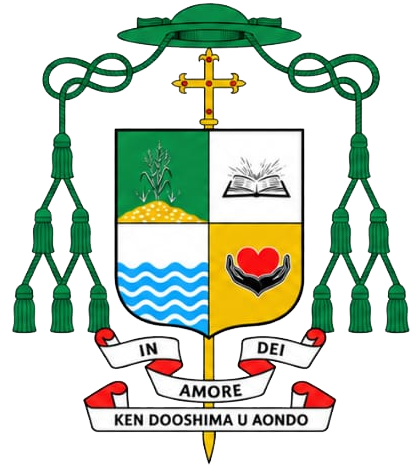
On the coat of arms of the Most Rev Isaac Dugu, the Catholic Bishop of Katsina-Ala, one notices different colours, images and symbols as well as his episcopal motto. The motto in Latin reads as “In Dei Amore”, and translates in Tiv language as "Ken Dooshima U Aondo”, and in English as “In God's Love”, respectively. This Motto places the pure, unconditional and infinite love of God, and our reciprocal response to this love, at the centre of the vision, life and service of the episcopacy of Bishop Isaac Dugu.
A closer look at the shield on Bishop Dugu's coat of arms reveals a predominance of the colour white, a symbol of purity and sanctity. The colour white also sets off the flowing scrolls that proclaim the episcopal Motto in two languages. In this white colour, we see a representation of the sainthood of the 'servant of Christ', the first Bishop of Katsina-Ala Diocese, Most Rev. Peter Adoboh of blessed memory. The white also stands for Bishop Dugu's commitment to purity of heart and purpose as a cardinal characteristic of his episcopacy.
In the right upper quadrant, the Holy Bible, depicting the Word of God, is highlighted against a pure white background. The presence of the Bible is also linked to one of the major visions of Bishop Dugu's episcopacy; "The Word of God". The Bible radiates sparkling rays of light, indicating the limitless light of Christ, illuminating the Diocese for the salvation of souls. In the lower left quadrant, the same white colour flows around and within the River Katsina-Ala, permeating the rolling blue waves of water with purity, renewal, refreshment and wellbeing. The river is not just a physical reality, but represents much more, namely, the spiritual reality of the waters of Baptism (Mt. 28:18-20), and of casting the net deeper into the waters to fish out men and women as Disciples of Christ (Lk. 5:4).
On Bishop Dugu's coat of arms, the colour green also plays a dominant role. Green depicts peace, tranquillity, renewal, and progress. In the upper left quadrant of the shield, we see a promise of fertility, growth, and hope depicted in the sprouting crops. This image symbolizes not just the fruitfulness of the land for which Katsina- Ala is known, but also a land that is fertile and receptive to the Word of God, and promises a rich harvest of souls for Christ. The warm orange-yellow earth from which new life springs forth and blossoms represents happiness, freshness, positivity, optimism, and a path to success for the Diocese.
In the lower right quadrant, the same deep yellow colour, expressing joy, warmth and enthusiasm, surrounds the image of God's Love, depicted as a heart cradled by two hands. We are indeed, In God's Love', held with loving tenderness and inscribed upon His loving palms. In addition, the hands bear an impression of black and white, symbolic of the identity of the Tiv people of Benue State, the place of primary evangelisation of the Bishop.
There are poignant splashes of red recurring on the body of the coat of arms. Red, expresses our solidarity with martyrdom. It a life of witnessing even to the point of death. The red colour is also a symbol of solidarity with all the innocent blood, which has been shed during the periods of protracted unrest witnessed in the Diocese. This regrettable unrest has claimed the lives of our people. This scenario is also represented in the five red jewels on the Episcopal Cross. These five jewels are also reminiscent of the five wounds of Jesus on the tree of the Cross.
The Cross on the coat of arms calls to mind our Saviour's redemptive sacrifice for our salvation (Heb. 10:1-19). It is the undeniable sign of the Trinity, anchored in the Love of God the Father, God the Son and God the Holy Spirit. The Cross is wrought in a deep gold colour, signifying the royalty of Christ our King, who has established his reign in the diocese. The same gold colour is encircled by the girdle, tassels and the shepherd's hat. The shepherd's hat reminds all of the role of the Bishop as a pastor and guide, representing Christ the Good Shepherd. In the light of this, he must carry out his work in humility, zeal and fortitude. The Good Shepherd is girdled to govern, to bless and sanctify the people of God towards the unity of God the Father, the Son and the Holy Spirit.
The entire coat of arms is whole and complete, with no part standing alone, and no loose ends. Each of the images and symbols is connected to the others, symbolising the unity and connectedness of the Diocese as the Body of Christ. The knitted looping chords of the girdle flow down to the tassels, which in turn touch the scroll that bears the Motto. In this way, the girdle encircles the entire coat of arms, and binds it firmly together in unity.