The Liturgical year begins on the first Sunday of Advent. It is divided
into six seasons. The shortest but most holy season is the three day
Sacred Pascal Trdiuum leading up to Easter
THE CATHOLIC LITURGICAL YEAR
THE CATHOLIC LITURGICAL YEAR
The Catholic Liturgical Year refers to the Church's organization of her celebrations of
various events in the life of Christ and the mysteries of the faith throughout the year.
During the course of the liturgical year, the Church celebrates the whole mystery of
Christ, from His Incarnation and birth to His Ascension, to Pentecost and the
founding of the Church, and finally to the second coming of Christ in judgment on
the Solemnity of Christ The King. On Sundays in particular, the Church
commemorates the Resurrection, when Jesus triumphed over sin and death. In other
instances, the Church also honors the Blessed Mother, commemorating the mystery
of salvation. Furthermore, within a liturgical year, the Church also celebrates the
memorial days of Saints, who through their lives bring to the minds of the faithful
the call to holiness and of whom the Church wants her faithful to emulate. The
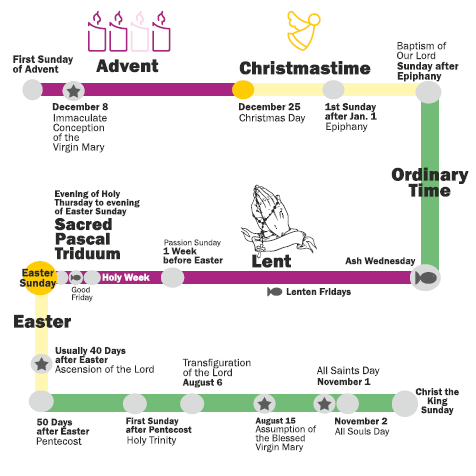
Church's liturgical year consists of six (6) seasons: Advent, Christmas, Ordinary
time (after Epiphany), Lent, Easter, and Ordinary Time (after Pentecost). Seasons
begin or end based on a movable feast and so some seasons vary in length from year
to year, and vary as to the calendar dates. The readings are arranged on a three Cycle
of A, B and C for Sunday readings and I and II for weekday readings.
After the fall of the Roman Empire and the surge of the Christian faith, the Catholic
Church eventually became the custodian of the law, education, and administration
throughout much of Europe. Eventually, with the separation of the Church from the
secular state, it became necessary to keep two calendars: one Civil or Secular, the
other Religious or Liturgical. The liturgical calendar keeps schedule of liturgical year,
which includes mostly celebrations and commemorations of certain major events in
the lives of Jesus Christ, Mary and the Saints. Before the Second Vatican Council, the
Church had just one sequence of the readings, probably; just A. the Division into the
various Cycles (A, B, C, I and II) came as one of the goals of the Second Vatican Council
to draw Catholic faithful more into the Scriptures. Hence, Sunday readings are on a
three year cycle A, B and C. In Year A, the Church reads primarily from the Gospel of
Matthew; in Year B, the Church reads primarily from the Gospel of Mark and in Year
C, the Church reads from the Gospel of Luke. The Gospel of John is covered
extensively in the seasons of lent and Easter. By this arrangement, if one attends
Mass religiously for three years or privately reads through the portions selected in
the liturgical calendar for three years s/he would have covered a considerable portion
of the Bible, in both testaments.
Ranks of Liturgical and Days of the Celebrations of the Church
Each day of the year has a designated celebration and these are themed the
celebrations of the Church, grouped into Solemnity, Feast, Memorial, and Holy days
of obligation
Solemnity:
The name 'Solemnity' comes from the Latin word 'Sollemnitas' meaning 'a festival'. It
is a liturgical celebration of the highest rank in the Catholic Church. It consists of
celebrating the mysteries of faith such as the Trinity; an event of the life of Jesus, His
mother Mary, or another important Saint in the Church. Normally, the celebration of
solemnities begins with a Vigil Mass on the evening before the actual date of the
celebration. Unlike feasts or memorials, solemnities are like the celebrations of
Sundays and they are in fact to some extent regarded by the Church as Holy days of obligation. This is to say that solemnities have the same dignity as a Sunday. During
the Mass of the Solemnities, there are two readings before the Gospel and both the
Gloria and the Creed are always recited as it is applicable on Sundays. The colours of
solemnities are always white or gold. For the solemnity of SS Peter and Paul, red is
used.
Feast:
Feast Days are days which are celebrated in commemoration of the Sacred mysteries
of the Church; the events recorded in the history of redemption of mankind; the
events in memory of the Virgin Mary or of the Apostles of Jesus; some of the
Christian Martyrs, and some of the Saints. A feast not only commemorates an event
or person, but also invites for a more access into the spiritual life of the person
celebrated by reminding us of the outstanding events in his/her life. Feasts are of
second importance to solemnities and are celebrated on particular days. There are no
Vigil Masses as in solemnities. An exception to this is the Feast of the Presentation of
the Lord which is preceded by a vigil and has its own vespers. More so, on feast days,
the Gloria is recited. Colour of vestments here varies, depending on the feast
celebrated.
Memorial:
Feast Days are days which are celebrated in commemoration of the Sacred mysteries
of the Church; the events recorded in the history of redemption of mankind; the
events in memory of the Virgin Mary or of the Apostles of Jesus; some of the
Christian Martyrs, and some of the Saints. A feast not only commemorates an event
or person, but also invites for a more access into the spiritual life of the person
celebrated by reminding us of the outstanding events in his/her life. Feasts are of
second importance to solemnities and are celebrated on particular days. There are no
Vigil Masses as in solemnities. An exception to this is the Feast of the Presentation of
the Lord which is preceded by a vigil and has its own vespers. More so, on feast days,
the Gloria is recited. Colour of vestments here varies, depending on the feast
celebrated.
Holy Days of Obligation:
The days designated as Holy Days of Obligation by the Church are Solemnities and
special liturgical feasts that honor the mysteries of the Lord, the Virgin Mary, and the
Saints. As Catholics, we are mandated to attend Mass at least once for the day
(Canon, 1247). Besides this, we are also to stay off from work and labour to preserve
the Sacredness of the day and not hinder the worship owed to God, the joy proper to
the Lord's Day, the performance of the works of mercy, and the appropriate
relaxation of mind and body (CCC).
Canon 1246, paragraph 1 states that Sunday, the Lord's Day, on which the paschal
mystery is celebrated, is by Apostolic tradition to be observed in the universal
Church as the primordial Holy day of obligation. Besides Sunday, the following days
must also be observed as Holy Days: The Nativity of our Lord Jesus Christ; The
Epiphany; The Ascension; The Body and Blood of Christ; Holy Mary the mother of
God; Immaculate Conception; Assumption; Saint Joseph; The Nativity of Saint
John the Baptist, Saint Peter and Saint Paul; The Apostles, and All Saints.
However, with the prior approval of the Apostolic See, the conference of Bishops can
suppress some of the Holy days of obligation or transfer them to a Sunday (Canon, 1246 No. 2).
Months and Days of Special Devotion
In the Catholic Church, each month of the year is dedicated to a particular devotion.
The dedication is based on historical events or a particular aspect of the liturgical
calendar, or a combination of the two.
May Devotion:
In the Catholic Church, the month of May is especially dedicated to the Blessed
Virgin Mary. In this month, the Church and her faithful offer prayers and devotions
to Mary whom the Church recognizes as one of the principal participants in the
economy of salvation. In this special devotion we respect the special role Mary
played in our redemption. History indicates that there had been several devotions to
the Blessed Virgin Mary in the Month of May during the Medieval Days. It is not
actually clear whom or how the Month of May became the month of special devotion
to the Blessed Virgin Mary. But, ever since the apparition at Fatima, which began on
th the 13 of May, the Church generally gave much consideration to the month of May.
Principally, in his 1965 encyclical, Mense Maio, Pope Paul VI identified the month of
May as an opportune time to incorporate special prayers for peace into traditional
May devotions. ('Mense Maio', Encyclical of Pope Paul VI on Prayers during May for
Preservation of Peace, April, 29, 1965).
Therefore, we have a special responsibility as God's faithful or as God's family to
gather in this month and recite the Rosary and the litany. A plenary Indulgence may
be gained when the Rosary is prayed in a Church, in a family group, in a religious
community or in a pious fraternity.
October Devotion:
The month of October has been traditionally dedicated to praying the Holy Rosary.
There is a very significant story behind the declaration. In October 7, 1571, 'Catholic
League (an alliance of Spain, Venice, the Papal States, Genoa, Savoy, and Malta)
defeated the forces of the Ottoman Empire who sought to overtake Europe and
suppress the growth of the Church. Prior to the battle, Pope Pius V prayed the Rosary,
asking for Mary's intercession in victory and every man was encouraged to pray the
Rosary for victory. The battle was won divisibly. As soon as the men returned from
the battle, Pope Pius V declared a feast day for Our Lady of Victory. A Rosary
procession was offered in St. Peter's square and in time the whole month became
associated with the Rosary.
Pope Leo XIII officially established October as the Month of the Rosary in the year
1884. That year, he published “Superiore Anno”, an encyclical which focused on
recitation of the Holy Rosary as an essential weapon against evil. In it, he called the
Church to dedicate the whole of the month to praying the Rosary.
Solemnity of all the Saints:
All Saints Day which is officially designated as the Solemnity of All Saints is a higher
feast celebrated on the first of November in honor of all the Saints, known and
unknown. At first, only martyrs and St. John the Baptist were honored by a special
day. Other Saints were added gradually and increased in number when a regular
process of canonization was established. Pope Gregory III (731 – 741) consecrated a
st chapel in the Basilica of St. Peter to all the saints and fixed the anniversary for 1
November. A basilica of the Apostles already existed in Rome, and its dedication was
st annually remembered on 1 May. Gregory IV (827 – 844) extended the celebration on
st the 1 November to the entire Church.
Commemoration of All Souls:
The Church in her Wisdom teachers that there are three 'Churches': the Church
Triumphant which refers to the Saints; the Church Pilgrims which refers to the
Church on earth and the Church Sufferings which refers to our brothers and sisters
who had a good relationship with God and tried with their strength to follow the
dictates of their well-formed conscience but due to human frailty had not completely
atoned for their venial sins. The feast celebrated on the second of November is
particularly for the Church suffering.
This Doctrine of praying for the dead is inspired by the Biblical command recorded in
the book of Maccabees which enjoins religious faithful to pray for the dead 'that their
souls may rest in peace' and of Saint Paul's letter to Timothy of where he prayed for
the soul of Onesiphorus that; “The Lord grant unto him to find mercy of the Lord in
that day.” A Plenary indulgence applicable only to the souls in purgatory can be
gained by the faithful who have confessed, communicated and said the usual
prayers for the pope's intentions. We are enjoined to book and attend Mass at least
once on this day, praying for the dead and visiting the grave of the deceased. Priests
are mandated to celebrate three Masses on that day 6am, 12pm and 6pm. The Mass
at noon may be celebrated at the Priest's Cemetery or as otherwise arranged.
SEASONS OF THE CHURCH
Season of Advent:
The Church's New Year begins at Advent. The term 'Advent' is from the Latin word
“adventus” meaning 'coming'. It is a season observed in the Church as a time of
expectancy, like a pregnant woman and her family would, in great anxiety, awaiting the birth of their child. However, it is actually much more than this, because in this
season, the Church awaits, with hope, the fulfillment of the promise of love from
God to send His only Son for the salvation of mankind. Advent begins from Sunday
after the Solemnity of Christ The King and lasts four weeks. Advent marks the time
of spiritual preparation by the faithful before Christmas. Spiritual exercises like
Confession, Fasting, Devotions, Novenas and prayer gatherings and above all
expression of charity are concrete ways of preparing for the coming of the Lord.
When the Church celebrates the liturgy of Advent each year, she makes present this
ancient expectancy of the Messiah, for by sharing in the long preparation for the
Saviors first coming, the faithful renew their ardent desire for His second coming
(CCC, 524).
The colour chosen by the Church is Purple, an ancient indicator of sorrows and
unease. This captures the sorrows that had engulfed mankind after the sin of Adam
and Eve and of which the birth of Jesus promises to save humanity from. For proper
liturgical catechesis and aesthetics, the Church should be decorated in Purple and
the placement of advent wreath. The colors violet or purple in Advent helps us to
remember that we are preparing for the coming of Christ.
Season of Christmas:
Christmas is a combination of two Latin words, 'Christ' and 'Mass' and in a sentence,
th could read, the 'Mass of Christ'. Christmas season begins from the 25 of December,
the day the Church sets aside to celebrate the birth of Jesus Christ. This does not
mean that Jesus was born that same day. It was chosen by the Latin Church to replace
th the worship of the sun god by pagans. The Eastern Church still keeps theirs on the 6
of January. The most important issue is not the date chosen but what is celebrated –
the birth of the Savior. The Feast of Christmas lasts for twelve days, until Epiphany.
However, the time from Epiphany until the Baptism of the Lord is also included in
the Christmas season. During this period, the Church celebrates the faithfulness of
God in keeping His promise to mankind in the gift of His only begotten Son, Jesus.
The Church is happy because the long-expected hope has manifested and humanity
has another hope of eternal life after the first was dashed by Adam and Eve.
The colour of the season is white; a bright indication of Joy, Purity and Newness.
Besides this, gold could be used as a clear symbol of the kingship of Jesus. The
Church remains ornamented with Christmas decorations during this season and
other celebratory exercises like singing of carols, and the dramatic re-enactment of
the birth of Jesus is encouraged. Above all, particular attention should be paid to the
poor. Visits to correctionl centres and orphanages are encouraged.
Ordinary Time:
Because of the connotations of the term 'Ordinary' in English, many people think
Ordinary Time refers to the time of the Church's year that is unimportant. The word
'Ordinary' in Ordinary Time comes from the word 'ordinalis' meaning 'Counted Time' because the weeks are numbered from one to thirty-four. Literarily, it is a time
of stock taking. It is a feature of the post-Vatican II liturgical calendar. In the
traditional Catholic calendar (before 1970), the Sundays of Ordinary Time were
referred to as the 'Sundays after Epiphany' and the 'Sundays after Pentecost'. The
occurrence of Easter determines the length of this 'counted time'. Easter falls on the
st 1 Sunday after the first full moon after the spring equinox when the tilt of the
Earth's axis is inclined neither away from nor towards the Sun, the Centre of the Sun
being in the same plane as the Earth's equator. The timing falls between March 22
and April 25 ('Learning about Liturgical Seasons and Days' Catholic Education,
Archdiocese of Brisbane 2015). This time particularly falls during the time of growth
and harvest and is counted as days of hope and time to mature in one's faith. It
begins from Baptism of the Lord and ends on Ash Wednesday and resumes after
Pentecost and ends on Saturday after the Solemnity of Christ the King. The Church
chooses the colour Green seen everywhere in plants and trees to represent growth,
the renewal of spring grass, flowers and trees. Readings of this time often indicate
the early life and childhood of Jesus Christ, ministry of Jesus and His activities before
His death.
Season of Lent:
Lent is a penitential season of the Church carefully designed as a time for internal
self-recollection and reconciliation with the aim of strengthening the decaying part
of our Christian lives for a more cordial relationship with God most especially in the
coming Easter? Generally, Lent is regarded as the Christian season of preparation
before Easter. Ash Wednesday marks the first day and the beginning of Lent which
starts forty (40) days prior to the Mass of the Lord's super on Holy Thursday.
Altogether, it covers forty-six (46) calendar days, the four days accrue from Sundays
which, from tradition are days of rest and no form of penance is recommended for
that day. The Sunday in Lent have never been, and still are not, part of the Lenten
fast. Sunday, on which by apostolic tradition the paschal mystery is celebrated, must
be observed in the universal Church as the primordial holy day of obligation (Canon,
1246).
Furthermore, the forty (40) days mentioned here are the exact number of days, Jesus
Christ spent while fasting in the desert after His baptism by John the Baptist in the
Jordan River. By uniting ourselves each year to the mystery of Jesus in the desert, we
participate directly in His salvific act. It's no wonder, then, that from a very early
period in the Church's history, a literal forty (40) days of fasting has been seen as
necessity by Christians. It is worthy of note to prepare for Easter by observing a
period of fasting from food and other pleasure of the flesh; sincere repentance from
sin and spiritual discipline.
The liturgical colour chosen by the Church is Purple. This reflects the passion and
suffering of Jesus in the desert and later days to His crucifixion and death. From Ash
Wednesday, the mark of ashes given at the forehead serves as a symbol of penance and repentance. All images of Christ and the Saints are covered with purple and the
Altar is stripped of decorative flowers and ribbons. The austere picture given is of
liturgical significance. It signifies the ascetic life of Jesus in the desert.
Triduum
The Paschal Triduum is a separate season in the Church. Until very recently, the
liturgical season of Lent ran from Ash Wednesday to Holy Saturday, when the Easter
season begins at the start of the Easter Vigil Mass. From 1956, however, a new
liturgical emphasis was placed on the Triduum, understood at that time as
encompassing Holy Thursday, Good Friday, and Holy Saturday. With the reversion of
the calendar in 1969, the Triduum was extended to include Easter Sunday. Easter
Triduum begins with the evening Mass of the Lord's Supper, reaches its high point in
the Easter Vigil, and closes with Evening Prayer on Easter Sunday. ('General Norms
for the Liturgical Year and the Calendar'. Sacred Congregation of Divine Worship, p.
19). With the separation of the Easter Triduum as its own liturgical season, it
becomes the shortest, yet most Holy season in the liturgical year, leading up to
Easter.
Season of Easter:
Easter is the most important season in the Church's calendar. Easter season begins
with the Easter Vigil, which is celebrated on Saturday night. It is a celebration of the
very foundation of the Christian faith. Without Easter, the privilege we have as
Christians would not have been possible. The Resurrection of Jesus Christ gave life
to the Gospel and the Church and all those who believe. Because of this, the season of
Easter is a joyous season. The season begins from Easter Sunday and ends with the
celebration of the descent of the Holy Spirit upon the Apostles on Pentecost. Jesus
Christ's ascension into Heaven is celebrated forty days after Easter. Readings during
the Easter season focus on Jesus' teaching after the Resurrection. The Easter season
lasts fifty (50) days. The festive colours used during the Easter season are white and
gold which signifies purity and kingship of the Paschal Lamb.